Final Project: We are what we eat!

This was a very fun project to film and edit! I used Sony Vegas to edit, and my Samsung Galaxy S8+ to record the shots. I used a lot of sound effects from the internet such as the first 2 seconds of Guillotine by Death Grips, The Bazinga sound effect from the Big Bang Theory, and lastly the Home Depot Spotify Advertisement Song. I utilized the fade transition to make it more visually appealing for people to be turned into Snickers. I wish the project could have been longer, but I wanted to get this done before my final exams.

I wanted this project to be a continuation of my first video, “You are what you eat” However I wanted to tell it with an actual story in mind. I am a fan of Sci-Fi movies (Alien, Interstellar, Looper) and I drew some of my inspiration from these movies. I thought the video turned out pretty well and I was impressed with how my editing improved. I also used a tripod to have more stable shots which was a huge improvement from the last video. I still kept the format of the first video present in this video with the theme of turning people into Snickers’ bars.

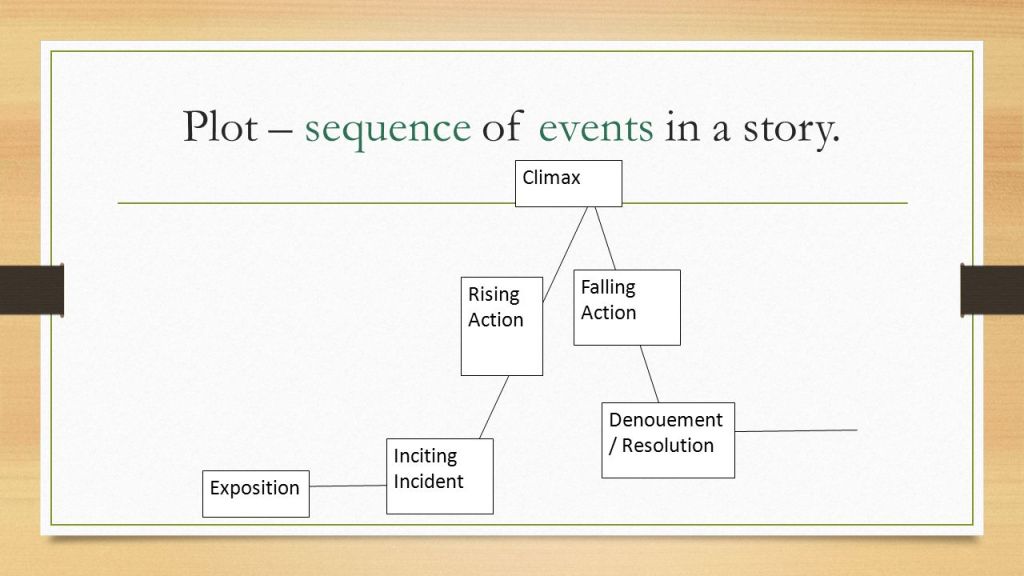
What I learned in this class was how to effectively tell a story with the sequence of events in a story: Exposition, Inciting Incident Rising Action, Climax, Falling Action, and Resolution. I also learned how to edit videos with more efficiency as well as provide an enjoyable story with my editing.
Speaker Reaction: Juan E Contreras

Speaker Juan E Contreras offered to us his knowledge about the three stages of video production: pre production, production and post-production. He also offered many points about proper framing. He reinforced the idea of different ways of framing by showing examples of successful ways to frame. He gave solid advice for shooting with a smart device. A couple of tips that helped me film my video project were to film horizontally and to avoid filming in a busy place where the phone could pick up unnecessary noise.

The main point that I got out of his talk was to avoid “editing it out in post”. Meaning that if I were to mess up a shot, I could just edit it out later. He instead told us to draw storyboards of each shot and film precisely so there would be less headache in post production. I took his advice and avoided a mess when filming my video project for this class.

You are what you eat.

This was a very fun project to work on. I used Adobe Premier to edit this video. I shot this with my Samsung Galaxy 8. I did not have a tripod to record a steady shot, so I improvised and used a fan to record each shot. My friend Derek generously participated in the video with his acting. The background music was from the Ultra-Lounge Vol. 4 Bachelor Pad Royale playlist.

My main goal was to create an intentionally bad snickers commercial that would show-up at 4am on Adult Swim. I really liked phasing my friend Derek into a snickers bar. It’s probably the best editing I have ever done. I tried to do it as a reference to this classic video. I also tried to employ different camera angle and utilize the rule of thirds in each shot. I made sure that each shot was a bit too long to add awkward tension to re-create that fake infomercial vibe . The story aspect of this video was to show that you are what you eat. literally. If I were to do this again. I would definitely added more people turning into snickers.

City Animation.

This week, my goal was to design a short animation that was between 30 seconds and 3 minutes. I am not the best artist, but I really like to sketch buildings and roads when I am bored. (Partly why my major is civil engineering). The basic idea of the animation was to design a city layout with roads and highways next to an ocean. I liked the choppiness of the video to show that the building process of cities aren’t always perfect.

I used my phone and a water bottle (as a stand) to take around 300 pictures. I then used an app called PicPac to combine all the images and add music to the video. The music is from a royalty free website called Bensound. I would have liked to do this project on a whiteboard. I could have been more creative and colorful, but I think the grid paper suited the purpose of the city design process just fine.

The time I went to Disneyland!

In this podcast, I tried to tell the story of when I went to Disneyland last summer! As a musician, I have learned how to mix and record audio. I recorded my voice with a Rode M5-mp condenser mic. I usually do not record my voice so it was weird trying to mix with it. I then used the program Reaper for compression and EQ to make my voice sound more “radio” like. Unfortunately I did not have a pop-filter so my P’s and S’s sounded a bit popped. The music in the background is by Lupin the Beatsmith

I really liked how the podcast turned out. I am glad I had some experience with recording and mixing audio, otherwise this would have a been difficult project for me. I really wish I could have included images to show what my experience was like. I am glad I was able to share my story of going to Disneyland!

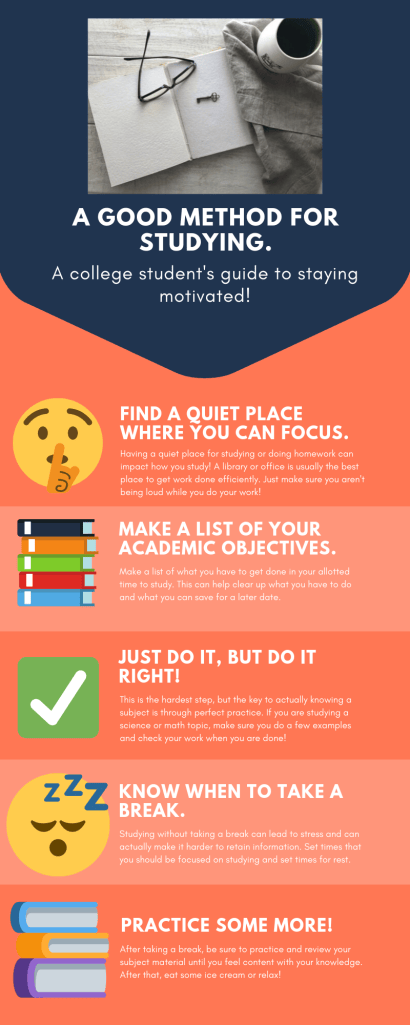
A college student’s guide for studying!

In this infographic, I tried to lay out a good plan for studying. I made this infographic on canva. At first I had these flashy images that were really nice. Unfortunately they costed money. After tweaking with canva, I was able to download this infographic for free without any problems.

One criticism I have with this project is that the images are not very high quality. Unfortunately I am a broke college student so I am not paying $10 for two images of a library. There isn’t really a story element to this infographic other than the guidelines that list how to study (which is still super important!). Overall I really liked the color scheme as well as the methods listed for studying!

Single Image Project

Reflection:

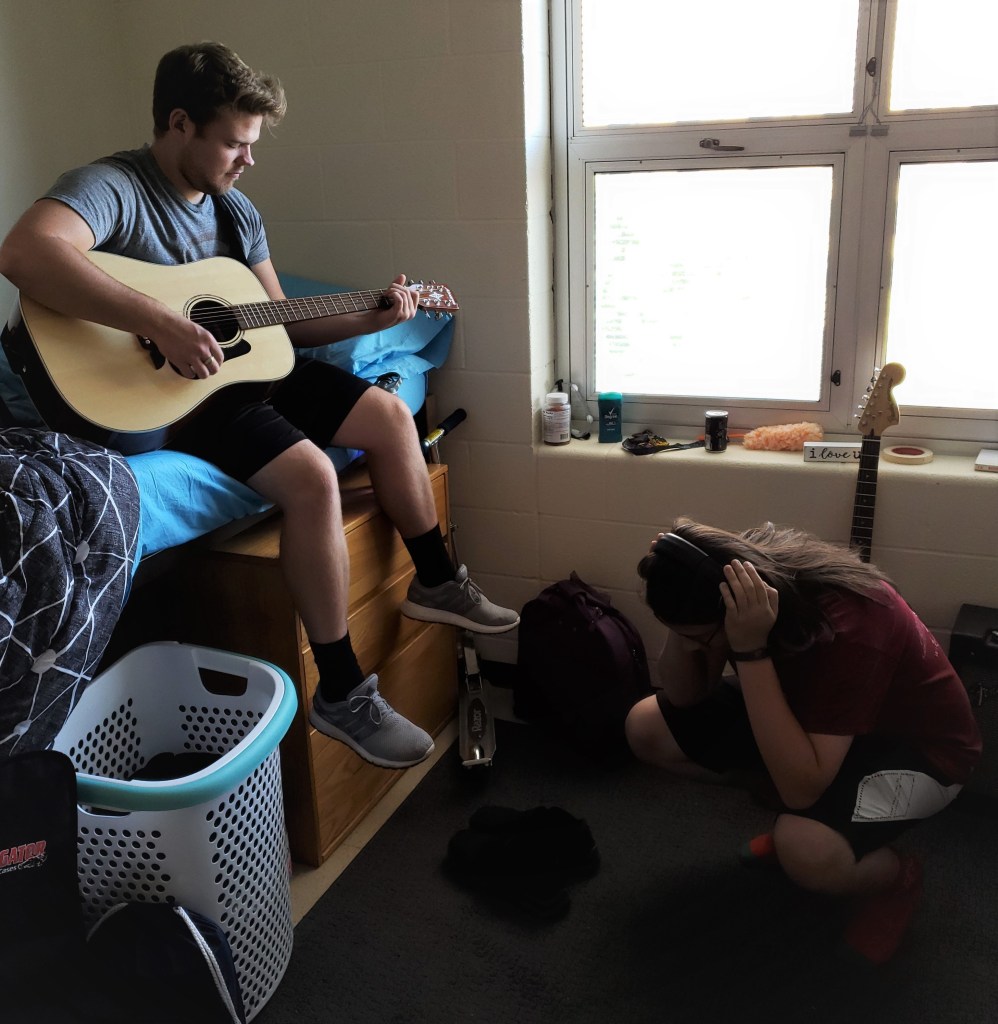
With this single image, I tried to capture the essence of my friend Dekin playing guitar and my roommate Jacob trying to block the noise out! I only had my phone to take the shot and Dekin happened to have his guitar with him that day. I think it turned out to be a pretty interesting story

I really liked how the lighting came out in this picture. I tried to follow the rule of thirds by cropping the image in Photoshop. One criticism that I have is the fact that my guitar looks like it is coming out of Jacob’s (right) back like Godzilla. I think the story is pretty easy to follow. This was obviously shot in my dorm room, so the photo already gives off a setting being about college students living on campus. The guitar and headphones on Jacob convey to the audience, that the guitar playing is probably unpleasant or loud. If I did this again, I would have definitely taken the picture in a cleaner environment so there would be less to look at besides the main focus.

Through this project, I learned that quantity helps when taking a photo that will capture everything. For this project, I took about 12-15 photos, but only 2-3 photos were decent enough to be used. I also learned how to manipulate images (cropping and brightness) through Photoshop which was pretty neato!

Augmented Reality is Revolutionizing the Publishing Industry. [Reading Reaction 2]

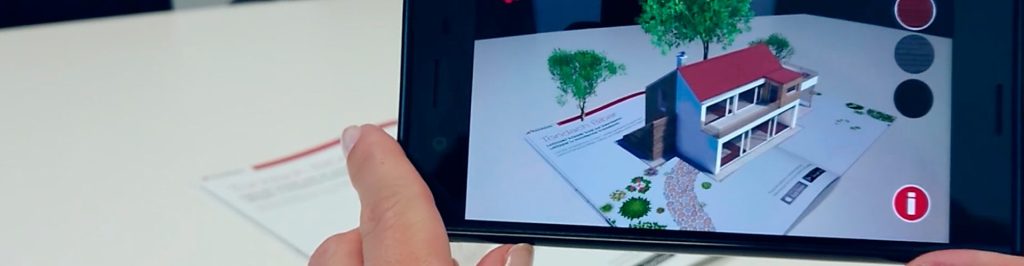
Tim Bajarin offers an interesting take on how AR (Augmented Reality) technology could revolutionize the way we consume media. He gives an example of how the company Aurasama implemented a way for readers to scan their magazine and learn more about an article with the tap of a button. Bajarin also went into detail about a book called, “The Human Face of Big Data”. The book featured AR abilities that allowed the reader to pull up online articles and TED talks about certain topics in each chapter.

Judging from the fact, that this article was written in 2012 and that the company Aurasama was bought out by Hewlett Packard, it is safe to say that AR tech has not revolutionized the publishing industry as much as Bajarin thought it would. I think it is highly impractical to be reading a paper article and have to pull up your phone, when instead, you could just have the article on your phone with all the additional sources at the bottom. I will agree that AR has made a significant impact on the entertainment and gaming industry. For instance, games like Pokemon Go and Harry Potter Wizards Unite have brought people together to go explore and collect items with the use of AR technology on their phone. There is a demand for AR technology in the entertainment and gaming industry, but I feel that AR is more of a gimmick for anything else.

Max to the rescue! Project – 1

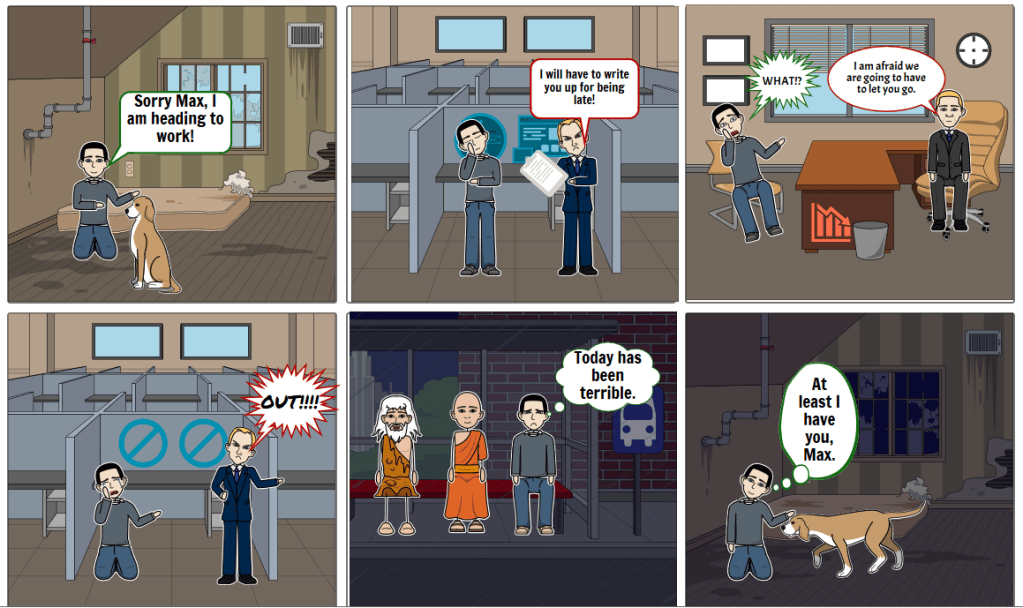
The basis of this story is about a man who lives in a cheap apartment with his dog Max. The man is late to work due to not having reliable transportation and is terminated from his job in the third and fourth panel because of this. He is miserable as he waits for the bus, but ultimately is happy that he still has his loving dog, Max by his side.

I wanted to create a story involving pets and their impact on our mental and emotional health. As a proud owner of two cats and one dog, I can safely say pets can help you out during tough times. I used the website “Storyboard That” to create the comic panel. I wish I could have implemented two or more panels into the comic to add some depth to the story, however the website’s free version only allows comics up to six panels. That being said, It was a fun process that I really enjoyed.

10 Simple Rules of Visual Storytelling.

The article 10 Simple Rules of Visual Storytelling, by Ernesto Olivares, lays down the fundamentals of visual storytelling with 10 broad rules:

  • 1.) Show, don’t tell.
  • 2.) Context is everything.
  • 3.) Show people.
  • 4.) Be personal, be true.
  • 5.) Show conflict.
  • 6.) Reveal hidden things.
  • 7.) Focus.
  • 8.) Keep moving.
  • 9.) Don’t be obvious.
  • 10.) Teach something.

Each of these rules are simple, yet highly effective for telling an engaging and memorable story. To give clarity to each of the rules, Olivares included references to popular movie titles that effectively utilized each rule and were able to stand out from the rest. A notable excerpt from the article was on the topic of sharing your true experience.

Share your true story and you’ll be setting yourself apart from all the other brands out there. They can’t share that same story, because they are not you.

Ernesto Olivares

The storytelling example that was given to support this statement was, Spielberg’s Schindler’s List. A movie about a true story which took place during the Holocaust. Spielberg’s earlier works were mainly science fiction and had not won any awards. However after Schindler’s List, Spielberg had started to become a recognized director.

I really enjoyed reading through the article and exploring why I enjoy some of my favorite movies. These rules could be compared to a formula for creating an entertaining story. I am sure that you don’t have to follow all of these rules to have a great story, but it at least guides the creative process in the right direction!

Create your own website, free on WordPress.com.Create your own website.
Start free